

All About
Capybaras
and how they fit into our world.
and how they fit into our world.


A rodent of unusual size. Is it a beaver without a tail? A hairy pig without a snout? No, it’s a capybara, the largest rodent in the world! Standing 2 feet (60 centimeters) tall at the shoulder and built somewhat like a barrel with legs, the “capy” has long, light brown, shaggy hair, a face that looks like a beaver’s, no tail, and slightly webbed feet. Originally thought to be a pig of some sort, we now know that the capybara is a rodent, closely related to cavies and guinea pigs.
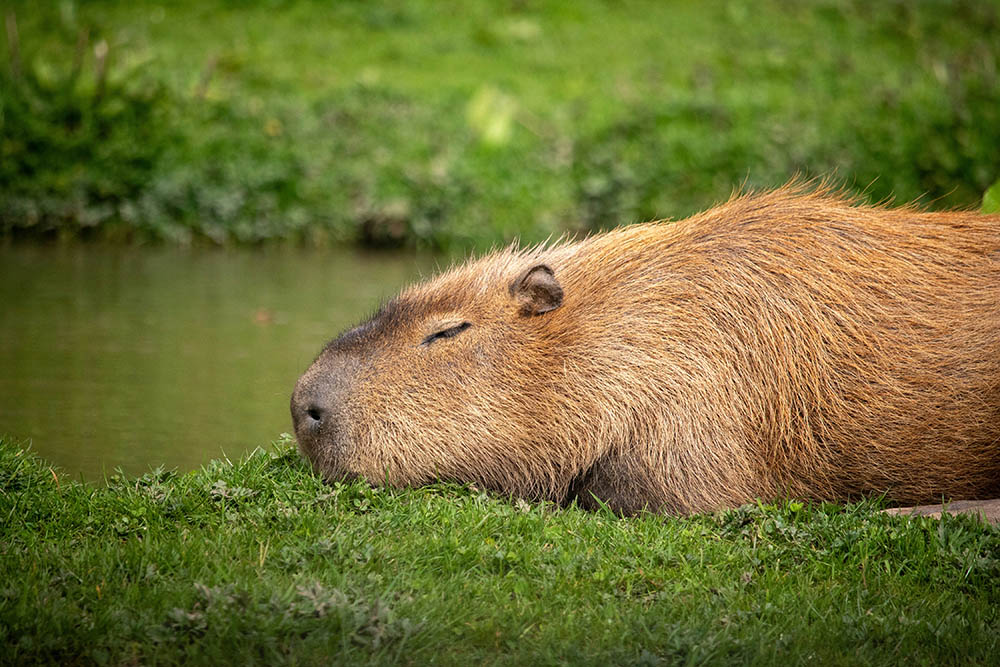
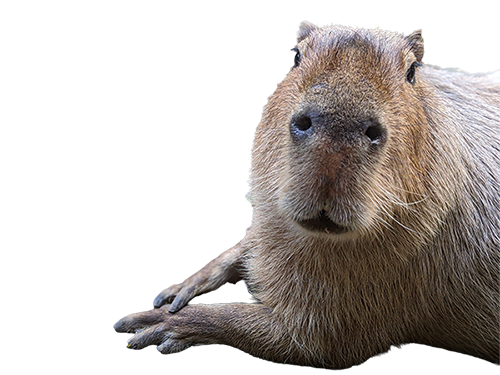
Africa has hippos, and the Americas have capybaras! Capys are found east of the Andes on Central and South American riverbanks, beside ponds, and in marshes or wherever standing water is available. Due to its dry skin, a capy requires a swimming hole as part of its lifestyle to stay healthy.
Water is a source of life for the capybara, as they eat water plants and grasses and use the water itself to escape from danger. In fact, a capybara can stay underwater for up to five minutes at a time to hide from predators. It uses those webbed feet (four toes on each front foot and three on each back one) to swim as well as walk.
The capybara has something in common with the hippo: its eyes, ears, and nostrils are all found near the top of the its head. A capybara can lift just those parts out of the water to learn everything it needs to know about its surroundings while the rest of its body remains hidden underwater.
Capybaras also wallow in shallow water and mud to keep cool during a hot day before wandering out in the evening to graze. They tend to eat around dawn and dusk, but if capybaras feel threatened, they wait until the safe cover of night to eat.

In the wild, capybaras live for about seven years on average, but some can live as long as 10 years. In captivity, however, their average lifespan increases greatly. In zoos, capybaras tend to live for 12 years, almost double their average lifespan in the wild.